
Poland is catching up with Western Europe in terms of earnings, but there’s another side to the coin. Prices are rapidly increasing. Consequently, the price advantage over wealthier EU countries is diminishing. In 2025, the average consumer basket cost 73.3% of the EU average.
For years, prices in our country have been rising faster than the EU average. In recent years, at their peak, annual increases reached 18%. This is gradually narrowing the price difference for similar goods and services.
Dalszy ciąg artykułu pod materiałem wideo Wpływ transformacji technologicznej oraz AI na sektor finansowy
Ceny w Polsce i UE. Przewaga cenowa nad bogatszymi krajami UE maleje
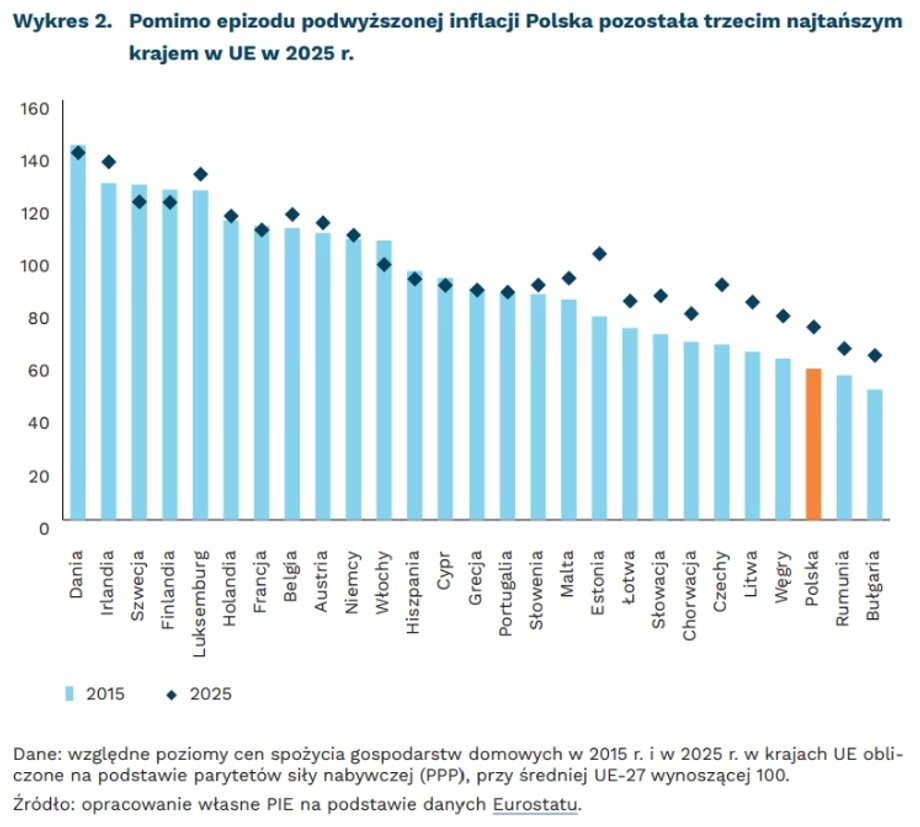
„Poland is rapidly closing the price gap separating it from European Union countries,” notes the Polish Economic Institute (PIE). It recalls that back in 2015, the average price level of consumer goods in Poland was less than 58% of the EU average. However, by 2025, the average consumer basket already cost 73.3% of the EU average.
„A particularly dynamic increase in the relative price level occurred between 2020 and 2025, when Poland, along with Estonia, was among the Central and Eastern European countries most rapidly reducing the price gap to Western Europe. This process was driven, firstly, by the stronger impact of the energy shock in Poland than in Western Europe, related to the economy’s high energy intensity and the significant share of energy and food in the consumer basket. Secondly, by the rapid wage growth, which increased labor costs and contributed to price increases, especially in the service sector,” analyzes the situation Hubert Pliszka, a PIE expert.
Poland’s prices are approaching Western levels but still lag behind. We remain among the cheapest countries in the EU. In 2025, only Romania and Bulgaria were cheaper than Poland, with prices reaching 65.1% and 62.5% of the EU average, respectively.
The question arises why prices are lower in Poland compared to other economies in the Central and Eastern European region. PIE indicates that this is due, among other things, to the effect of a deep market, which promotes competition and limits profit margins in retail.
The countries with the highest prices in the entire EU have consistently been three nations since 2018: Denmark, Ireland, and Luxembourg, whose average price levels in 2025 exceeded 130% of the EU average.
Prices in Poland and the EU. A system of interconnected vessels
„The acceleration of price convergence in Poland over the last five years has been driven primarily by those expenses that households cannot easily reduce: food, energy, and services,” lists Hubert Pliszka.
He adds that while prices for gas and electricity have nearly doubled, and prices for hairdressing, dental, and renovation services have increased by almost 70%, prices for many industrial products have remained relatively stable.
On the other hand, it is the prices of consumer services that are still significantly lower in Poland than in Western Europe. In 2025, service prices hovered around 60% of the EU average, while prices for clothing, cars, or home appliances nearly matched prices in other EU economies.
„Poland’s catch-up with Western European price levels is, in the long term, a consequence of participation in the common market and progressing real convergence,” explains the PIE expert.
He notes that structural factors, such as the absence of trade barriers, the free movement of goods, people, services, and capital, and the gradual harmonization of regulations, contribute to the disappearance of price differences for goods within the EU. Furthermore, in less developed economies, faster productivity growth in the export sector leads to wage pressure also in the segment of services not subject to international trade, resulting in price increases in this part of the economy. Consequently, as Poland catches up with richer countries in terms of income and productivity, its prices naturally also approach their price levels.
Dziękujemy, że przeczytałaś/eś nasz artykuł do końca. Bądź na bieżąco! Obserwuj nas w Google.