
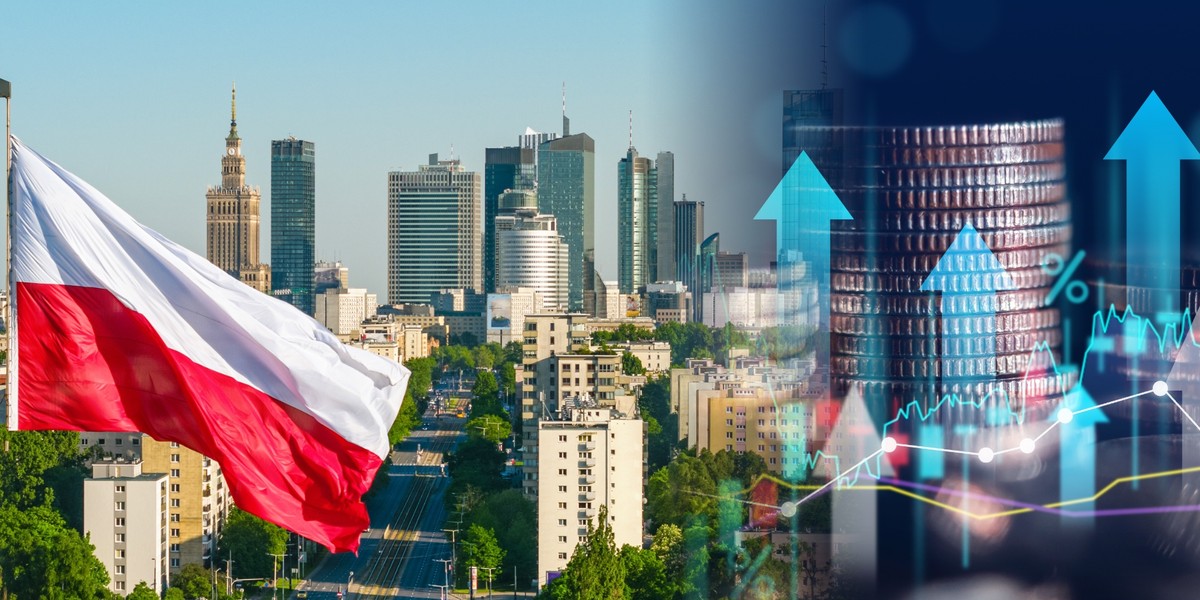
The Polish economy is withstanding the turbulence caused by the Middle East conflict, according to an analysis by the Polish Economic Institute (PIE). The European Commission has not lowered its growth forecast for Poland, placing it among a select few resilient economies in the EU.
Continued article below the video material Expert on Poland’s future. He talks about how much a pension will be in 30 years
In the latest EC projection, most countries experienced downward revisions. The forecast for Germany dropped by 0.6 percentage points, for Sweden by 0.8 percentage points, and for Romania by as much as 1 percentage point.
Poland, as one of the few countries, has maintained its previous forecast – a GDP growth of 3.5% in 2025. This result is primarily driven by stable private consumption and increasing investments, largely financed by EU funds.
Data confirms resilience
PIE experts point out that macroeconomic estimates support an optimistic scenario. Poland’s GDP in the first quarter of 2026 grew by 3.4% year-on-year, almost perfectly aligning with annual forecasts. Quarter-on-quarter, the economy expanded by 0.5% after seasonal adjustment.
This indicates that despite global tensions, the pace of growth remains steady.
Read also on BUSINESS INSIDER
Poland much more resilient to crisis than Germany. Such cuts do not threaten us

Read also: Poultry exports to China may soon start. A key document is in place
KPO drives investment
The inflow of funds from the National Reconstruction Plan (KPO) currently plays a crucial role. The EC notes that record absorption of funds in the final phase of the program strengthens the investment impulse.
In 2026, increased public spending co-financed by the EU is expected to offset the anticipated slowdown in private consumption and sustain solid GDP growth.
Good news also comes from price data. In May 2026, inflation stood at 3.1% year-on-year, down from 3.2% the previous month and significantly beating market expectations of 3.7%.
PIE experts highlight that food prices proved crucial, unexpectedly falling by 1% month-on-month – contrary to the seasonal upward trend.
Core inflation also turned out to be lower than forecasts, amounting to approximately 3% year-on-year. This suggests that the rise in fuel prices did not translate into widespread price pressure in the economy.
Read also: Grzegorz Kołodko predicts a crisis in Poland. „It’s like a moth flying into a flame”
Fuel shock under control
This is particularly significant in the context of geopolitical tensions. The closure of the Strait of Hormuz in early March caused a surge in oil prices and was one of the main risk factors for inflation.
Read also: Orlen changed its price list on Thursday. All fuels increased
However, May data shows that the Polish economy demonstrated significant resilience to the energy shock. In the assessment of PIE experts, the government’s swift response played a significant role – reducing VAT and excise duty on fuels, as well as introducing a daily price cap at the end of March.
Additionally, signals of potential progress in US-Iran talks began to cool the oil market, reducing the risk of inflationary pressure returning in the coming months.
Thank you for reading our article to the end. Stay up-to-date! Follow us on Google.